Return on Prevention: Why leaders need to move beyond ROI

By Mike Hayden
Cyber Business Development Manager, Redcentric
The measurement problem
For decades, business leaders have relied on Return on Investment (ROI) to evaluate technology spending. The formula is simple: invest £1 and expect a measurable financial return.
But cybersecurity has always been different.
Unlike a CRM platform that improves sales productivity or a manufacturing system that increases output, cybersecurity’s primary purpose is to stop something from happening – success often looks like nothing at all.
No breach. No ransomware. No downtime. No regulatory fines. No front-page headlines.
As a result, security leaders frequently find themselves trying to justify investment using a financial model that was never designed for prevention.
Perhaps it’s time we stop asking, “What’s the ROI of cybersecurity?” and start asking, “What’s the Return on Prevention?”
Traditional ROI
Imagine a business invests £250,000 in Managed Detection and Response (MDR), Vulnerability Management, and Security Awareness Training.
Twelve months later:
- No ransomware attacks occurred
- No significant outages were experienced
- No customer data was compromised
- No regulatory action was taken
Was the investment worthwhile?
Traditional ROI struggles to answer this question because there is often no direct revenue generated.
Yet the organisation may have avoided:
- Hundreds of thousands of pounds in recovery costs
- Operational downtime
- Contractual penalties
- Lost customer confidence
- Executive and legal scrutiny
The security controls delivered value precisely because they prevented these outcomes from occurring.
Introducing Return on Prevention (RoP)
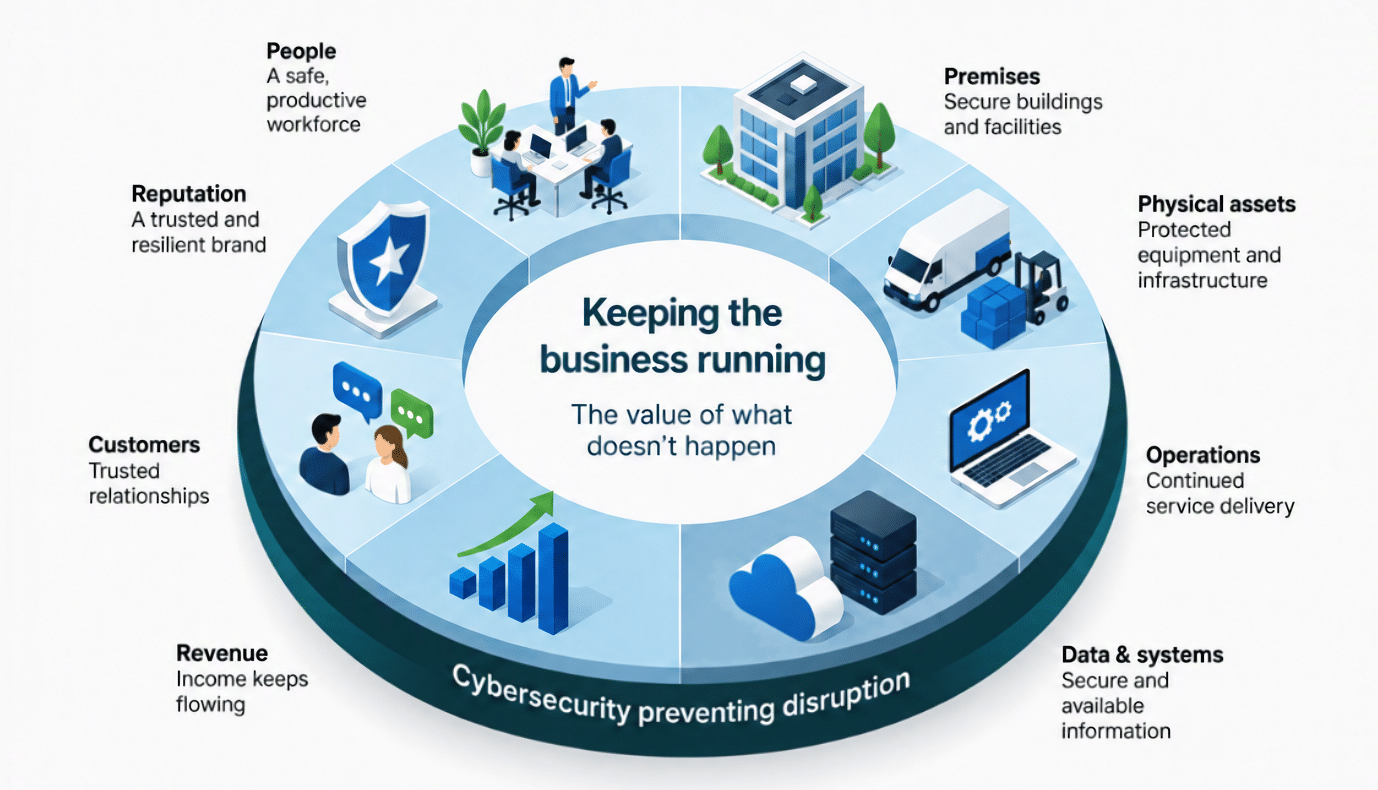
Return on Prevention measures the value created by reducing risk exposure and avoiding costly incidents.
Rather than focusing solely on financial gains, RoP considers:
- Risk reduction: How much has the organisation reduced its likelihood of suffering a successful cyber attack?
- Business continuity: How many operational disruptions have been avoided?
- Regulatory compliance: What potential fines, investigations, and legal costs have been prevented?
- Reputation protection: What is the value of maintaining customer trust and brand credibility?
- Resource efficiency: How much internal time has been saved through proactive security management?
The outcome is a more meaningful picture of how cybersecurity contributes to organisational resilience.
Cybersecurity is an insurance policy that works every day
Many executives readily accept investments in physical security, health and safety, or insurance without expecting a direct ROI. Nobody asks: “What is the ROI of the office fire alarm?”
The value lies in mitigating catastrophic events and cybersecurity should be viewed through a similar lens.
The difference is that cyber controls actively work every day by:
- Detecting threats before they become incidents
- Identifying vulnerabilities before they are exploited
- Reducing attacker dwell time
- Improving response effectiveness
- Strengthening organisational resilience
This is not merely insurance, it’s continuous risk reduction.
Measuring return on prevention
Organisations can begin quantifying RoP using metrics such as:
Incident avoidance
- Reduction in successful attacks
- Reduction in security incidents requiring escalation
Vulnerability risk reduction
- Percentage reduction in critical vulnerabilities
- Time to remediate high-risk exposures
Operational resilience
- Reduced downtime
- Faster recovery times
- Improved disaster recovery performance
Security maturity
- Improved security posture scores
- Increased compliance performance
- Enhanced cyber insurance readiness
Financial exposure reduction
- Estimated reduction in breach impact cost
- Reduced likelihood of regulatory penalties
- Lowered cyber insurance risk profile
While these figures may not be as precise as traditional ROI calculations, they provide a far more realistic representation of cybersecurity’s contribution to the business.
Why boards are starting to care
Boardrooms are becoming increasingly focused on cyber risk and the conversation has evolved from “how much does security cost?” to “how much risk are we accepting?”
This shift creates an opportunity for security leaders to speak the language of business.
Instead of presenting technical outputs such as:
- Vulnerabilities patched
- Alerts investigated
- Security tools deployed
They can demonstrate business outcomes:
- Risk reduced
- Downtime prevented
- Revenue protected
- Customer trust preserved
That is a far more compelling discussion.
My perspective: Prevention as a business enabler
I believe cybersecurity should be measured by the resilience it creates rather than the incidents it responds to.
Services such as:
- Managed Detection & Response (MDR)
- Vulnerability Management
- Security Operations Centre (SOC)
- Threat Intelligence
- Incident Response
all share a common objective: Prevent business disruption before it occurs.
The greatest success stories are often the incidents that never happen because risks were identified, prioritised, and addressed before an attacker had the opportunity to exploit them.
That is the real Return on Prevention.
My final thoughts
Cyber security is one of the few business functions where success can appear invisible. The systems keep running, employees keep working and customers keep buying. When viewed through a traditional ROI lens, that success can be difficult to measure.
But when viewed through the lens of Return on Prevention, the value becomes clear.
The question to ask is “what losses, disruption, and business risk did cybersecurity prevent?” and in today’s threat landscape, that may be the metric that matters most.